Screen Print vs DTG vs Embroidery: Which Decoration Method Fits Your Order
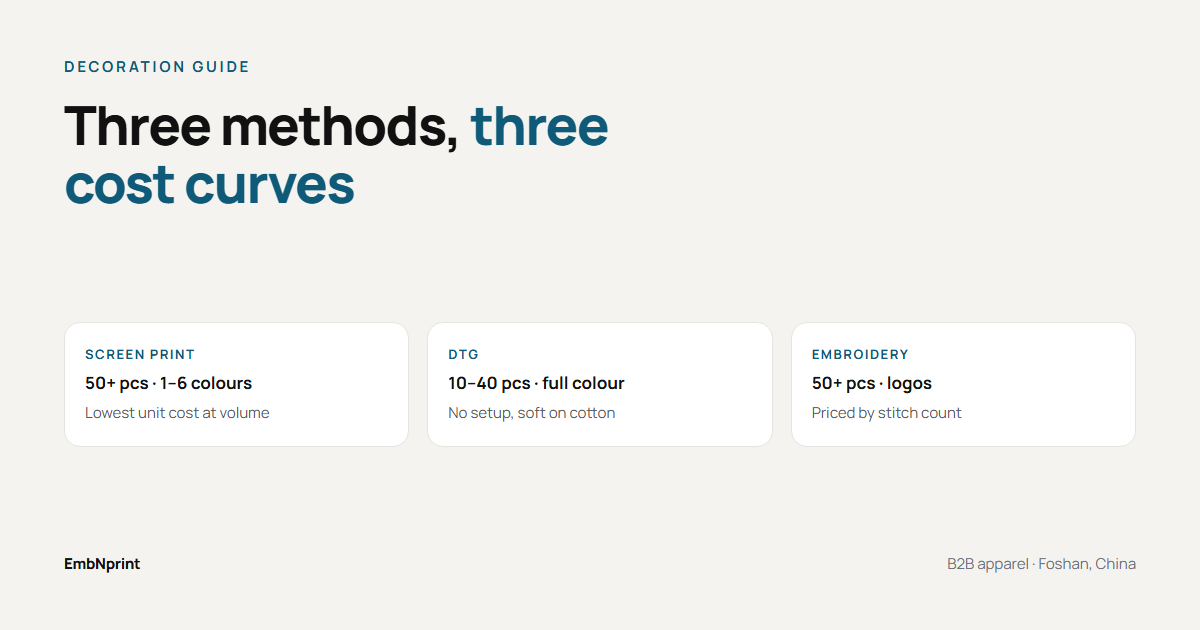
Three decoration methods, three different cost curves. Choosing the wrong one is the most common reason a garment programme feels expensive for what it is.
Screen printing
Ink is pushed through a mesh screen, one screen per colour. Setup takes time and material, but once the screens are made, pieces print fast and cheaply.
- Best for: 50+ pieces, 1–6 solid colours, bold graphics.
- Unit cost: high at 20 pieces, very low at 500.
- Hand feel: depends on ink — plastisol sits on top, water-based and discharge sink in.
- Durability: excellent, outlasts the garment in most cases.
DTG (direct to garment)
A modified inkjet printer prints directly onto the shirt. No screens, no setup — the file goes straight to production.
- Best for: short runs, full-colour or photographic artwork, variants and reprints.
- Unit cost: flat regardless of colour count, but higher than screen print at volume.
- Hand feel: soft on 100% cotton; noticeably stiffer on blends.
- Durability: good, with slightly lower wash resistance than a well-cured screen print.
Embroidery
Thread is stitched into the fabric. Cost scales with stitch count, not colours, which makes it the cheapest way to reproduce a multi-colour logo.
- Best for: logos, left-chest marks, caps, bags, uniforms, anything that has to look premium.
- Unit cost: driven by stitch count and size; stable from 50 to 5,000 pieces.
- Hand feel: raised and structured; not suited to fine gradients or small text.
- Durability: the highest of the three.
Decision table
| 10–30 pieces, full colour | DTG |
| 50–200 pieces, 2 colours | Screen print or DTG — compare landed cost |
| 500+ pieces, solid colours | Screen print |
| Logo on chest, cap or bag | Embroidery |
| Photo or gradient artwork | DTG |
| Names and numbers | Screen print, or DTG for one-offs |
Four mistakes that cost money
- Splitting colours across methods. A two-colour design printed with two techniques will not match. Pick one method per artwork.
- Ignoring fabric. DTG on polyester blends dulls and cracks; discharge printing only works on cotton.
- Underestimating setup. Six-colour screen print on 40 pieces carries six setups. The quote is correct; the brief was wrong.
- Designing for the screen, not the garment. Gradients, 1 pt text and photographic detail do not survive embroidery.
What the cost curve actually looks like
Absolute numbers vary with fabric, ink and freight, but the shape of the curve is consistent:
- Screen print: a fixed setup per colour plus a low per-piece cost. At 30 pieces the setup dominates; at 500 it disappears into the unit price.
- DTG: almost no setup, a mid per-piece cost that barely moves with quantity. Cheapest at 10–40 pieces, expensive at 1,000.
- Embroidery: a one-off digitising fee, then a per-1,000-stitch cost. The curve is nearly flat, which is why it stays competitive at both 50 and 5,000 pieces.
The practical rule: if your total run is under about 40 pieces, DTG or embroidery will usually land lower. Between 40 and 150, ask for both a screen print and a DTG quote — the crossover depends on colour count. Above 150 pieces with one to four solid colours, screen print wins on unit cost almost every time.
Mixing methods on one garment
Combining methods is normal and often the right answer: a screen-printed back with an embroidered left chest, for example. What does not work is splitting the same artwork across two methods, because the colours and edges will not match. Design each element for the process that produces it.
Lead time differences
Screen printing needs screens burned and cured between colours; DTG prints in one pass but needs pre-treatment on dark garments; embroidery needs digitising before the first stitch. In practice all three sit in the same 7–10 working day sampling window, but a six-colour screen print will add a day or two in production compared with a one-colour job.
How to brief a factory properly
Send: artwork in vector, target quantity per size, garment colour, deadline, and where the print sits. With those four things, any competent factory can recommend a method and give a firm per-unit price in one working day.