Embroidered Tote Bags Wholesale: MOQ, Fabric and Cost Drivers
Embroidered tote bags are one of the few promotional products people keep using after the campaign ends. That is exactly why the specification matters: a bag that fails at the handle or the base seam damages the brand it was made for.
Here is what actually drives the quote, and where buyers usually overspend or underspend.
Size groups and what they are for
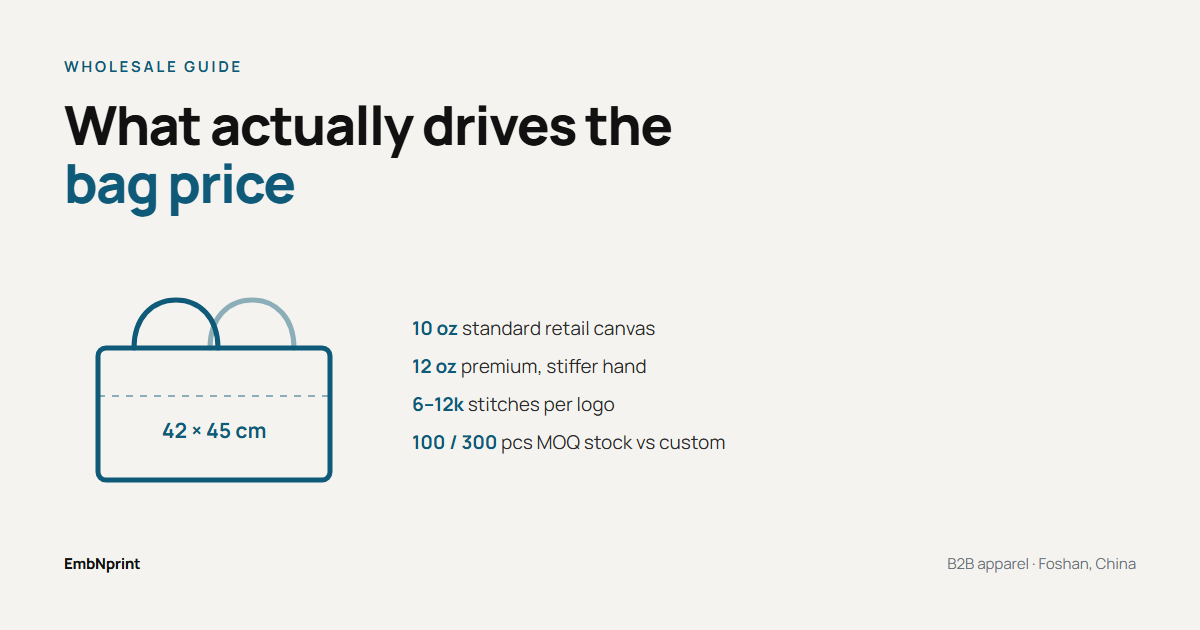
- Large (around 42 × 45 cm): grocery runs, retail packaging, conference giveaways. Needs a reinforced base and wider handles.
- Medium (around 38 × 42 cm): the default for brand merch and bookstore or cafe retail.
- Small and mini: gift-with-purchase, cosmetics, event lanyard alternative.
Size changes the pattern, so it changes the MOQ. A factory that quotes the same minimum for every size is either tooling nothing or hiding the setup cost.
Fabric: where most of the cost sits
Canvas weight is measured in ounces per square yard. 10 oz is the standard retail feel; 12 oz is stiffer and reads as premium; 8 oz feels thin and sags once loaded.
Also confirm:
- Composition — 100% cotton canvas, cotton-poly blend, or jute.
- Handles — same fabric as body, webbing, or cotton tape; stitched or bar-tacked.
- Lining — optional; adds structure and cost.
- Base — flat or gusseted. A gusset changes the pattern and the price.
Embroidery detail: stitch count beats colour count
Unlike screen printing, embroidery does not get more expensive per colour. It gets more expensive per stitch. A dense 8 cm logo on a coarse canvas can run 8,000–12,000 stitches; a simple line mark might be 3,000.
Practical guidance:
- Keep thread colours to 6 or fewer unless the artwork demands more.
- Ask for a stitch file proof, not just a rendered mockup.
- On dark canvas, a white underlay improves coverage but adds stitches and stiffness.
- Backing material matters on thin fabric — without it, the bag puckers.
MOQ: stock versus custom
Stock bag styles with your logo applied can start around 100 pieces per design, because the pattern already exists. Fully custom bags — your size, handle, lining and label — typically start at 300 pieces, because a new pattern and cutting run have to be set up.
Mixed sizes in one design usually count as one run. Mixed colours do not always; confirm before you plan a range.
Sampling and production timeline
- Digital proof: 24 hours
- Physical sample: 7–10 working days
- Production after approval: 10–15 working days for embroidery on stock styles
- Sea freight to Europe or North America: 25–35 days; air is faster and much more expensive per kg
Bags are bulky. Freight is often 15–25% of landed cost, so packing density is a real cost lever — ask how many pieces fit per carton.
Quality points to specify
- Stitch density and thread tension on the logo
- Handle attachment: bar-tack or box-X, tested by pull
- Base seam strength — the first failure point on loaded bags
- Colour fastness after washing
- Loose thread trimming and inside finish
AQL 2.5 inspection on the finished lot is the standard to ask for.
Where buyers overspend
Heavy 12 oz canvas for a short-lived event bag; six-colour embroidery on a 3 cm logo; individual polybags plus tissue plus box for a low-value item. Match the spec to the job the bag has to do.
See our embroidered bag range or send a brief with your size, quantity and artwork — we will quote the fabric, stitch count and packing before you commit.